I’ve been practicing law here in Oregon for years, and I can’t tell you how many times someone has sat across from me saying, “Brandon, we shook hands, I sent the money, so we’re good… right?” When it comes to selling a boat, that assumption can be a costly mistake.
A Boat Bill of Sale Oregon is a written legal document that records the transfer of ownership of a vessel from seller to buyer. It confirms who sold it, who bought it, how much was paid, and exactly what boat changed hands — including the Hull Identification Number and registration details required by the Oregon State Marine Board. It’s not just paperwork. It’s your protection.
In my experience handling private boat sales, title disputes, Marine Board rejections, and even lawsuits over engine failures, I’ve seen what happens when this document is rushed — or worse, skipped entirely. The difference between a smooth transfer and months of legal headaches usually comes down to how carefully this one document was prepared.
So let me walk you through what actually matters under Oregon law — not the generic advice you’ll find everywhere, but the practical, real-world guidance I give my own clients.

Free Printable Boat Bill of Sale Oregon
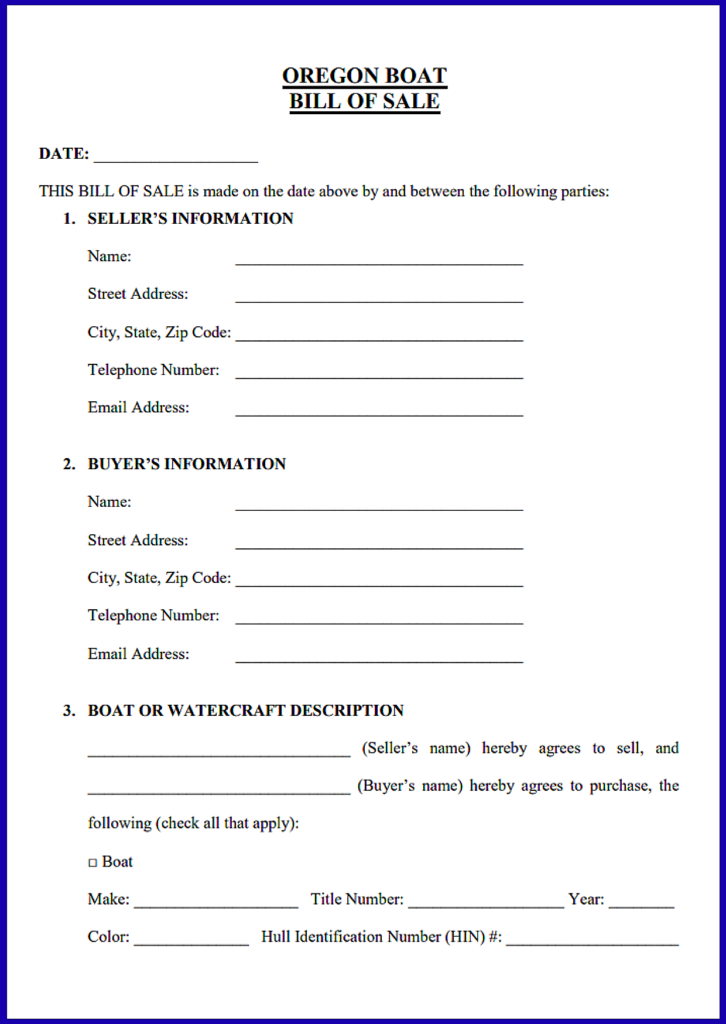
Over the years, I’ve had plenty of clients ask me if they can just download a free printable Boat Bill of Sale Oregon template and use it for a private sale. The short answer is yes — but only if it’s done correctly. A free form can absolutely work in Oregon, provided it includes the right legal details required by the Oregon State Marine Board and properly documents the transfer of ownership.
In my experience, the problem isn’t using a free form — it’s using one that’s incomplete or generic. If you’re going to use a printable version, make sure it captures the boat’s full description, Hull Identification Number (HIN), sale price, and “as-is” language. I’ve made a properly structured PDF version available, and you can download it in PDF format to ensure you’re using something that actually protects you under Oregon law.
Oregon Boat Bill of Sale Legal Requirements
| Topic / Issue | [OREGON] Legal Rule | Governing Statute |
|---|---|---|
| Governing Legislation | Oregon’s rules for small watercraft and vessels govern boat titling, certificates of number, registration, security-interest perfection, and transfer notifications through the Oregon State Marine Board. | ORS Chapter 830 |
| Commercial Sales | Oregon’s Uniform Commercial Code applies to sales of goods, including the Statute of Frauds and warranty disclaimers. | ORS 72.2010; ORS 72.3160 |
| Federal Law | Federal maritime law applies to U.S. Coast Guard documentation for commercial or qualifying recreational vessels. | 46 U.S.C. Chapter 121 |
| Jurisdiction | Boat titling, registration, and transfer reporting are handled under Oregon law, while federal law applies to Coast Guard-documented vessels. | ORS Chapter 830; 46 U.S.C. Chapter 121 |
| Recent Updates | Oregon State Marine Board administrative updates continue to address electronic titling, digital security-interest filings, and aquatic invasive-species prevention under ORS Chapter 830. | ORS Chapter 830 |
| Authorized Signers | The registered owner or transferor and transferee listed on the title assignment or bill of sale are the parties to the transfer. For goods priced at $500 or more, the document must be signed by the party against whom enforcement is sought. | ORS 830.710; ORS 830.810; ORS 72.2010 |
| Witness Requirement | No statutory requirement — governed by common law principles | N/A |
| Notarization Requirement | No statutory requirement — governed by common law principles | N/A |
| Age Requirement | Parties must be at least 18 years of age to possess full independent contractual capacity. | ORS 109.510 |
| Mental Capacity | No statutory requirement — governed by common law principles | N/A |
| Transfer Deadline | The owner must notify the Oregon State Marine Board within 30 calendar days of the transaction, and the buyer must apply for title transfer within 30 days to avoid late fees. | ORS 830.710(1) |
| Vessel Identification | The bill of sale must clearly describe the vessel, including the HIN, make, model, year, and length, to satisfy Oregon State Marine Board intake standards. | ORS 830.825 |
| Statute of Frauds | For a boat or watercraft sale priced at $500 or more, the agreement must be in writing, signed by the party against whom enforcement is sought, and include an explicit quantity term. | ORS 72.2010 |
| “As Is” Clause | To exclude implied warranties of merchantability and fitness in a private boat sale, the contract must contain conspicuous written language using terms such as “as is” or “with all faults.” | ORS 72.3160 |
| Filing Agency | The buyer and seller must fulfill transfer-reporting requirements and submit title and registration applications to the Oregon State Marine Board. | ORS 830.710; ORS 830.810 |
| Private Contract Status | The boat bill of sale functions as a private contract and supporting evidence of the ownership chain when submitted with official Marine Board title applications. | ORS Chapter 830 |
| False Information | Knowingly submitting false or fraudulent information concerning a boat transfer or ownership details is unlawful. | ORS 830.730 |
| HIN Problem | Transferring a vessel without a valid, untampered HIN violates Oregon hull-identification requirements and prevents the Marine Board from issuing a certificate of title. | ORS 830.825 |
| Active Security Interest | A vessel subject to a recorded security interest requires a formal written release from the secured party for the transfer process. | ORS 830.740; ORS 830.745 |
| Agency Difference | Oregon uses the Oregon State Marine Board rather than the DMV for motorized and qualifying sailing-vessel titles and registrations. Boat trailers are handled separately through the DMV. | ORS Chapter 830 |
| Sales Tax | Oregon imposes no statewide retail sales tax or use tax on private boat purchases or transfers. | Oregon state tax rule |
| Transfer Notice | Oregon imposes a statutory 30-day notice requirement on sellers transferring a vessel. | ORS 830.710 |
The biggest practical distinction is which agency handles the property. A boat itself goes through the Oregon State Marine Board, while a boat trailer is handled separately through the Oregon DMV. That means a combined boat-and-trailer sale can involve two different ownership processes.
The 30-day deadline is another rule worth taking seriously. The owner must notify the Marine Board of the transfer within 30 days, while the buyer must apply for the title transfer within that period to avoid late fees. Missing the required paperwork can leave the ownership records unresolved and create problems later.
The HIN is equally important. Oregon’s provided requirements call for the HIN, make, model, year, and length, and a missing or altered HIN can prevent the Marine Board from issuing a certificate of title. An active security interest creates another obstacle because the provided rules require a formal release.
For sales of $500 or more, the written-contract requirement also matters, while the “as-is” language must satisfy the stated warranty-disclaimer rule.
Vessel Boat Bill of Sale Oregon
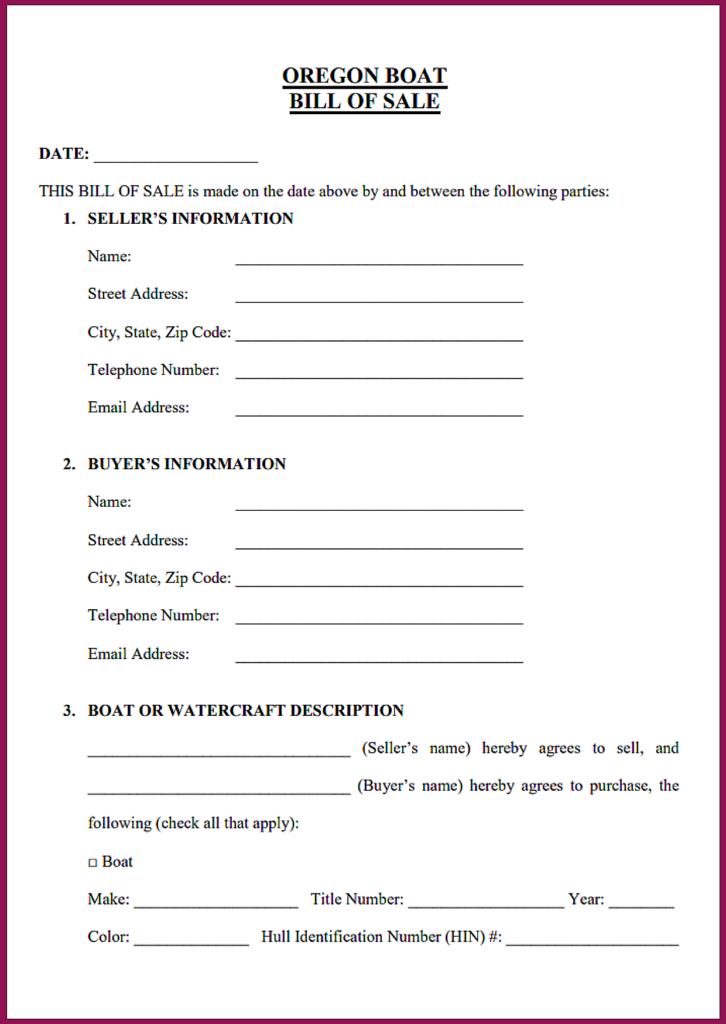
When we use the term “vessel” in Oregon, we’re talking about the legal classification recognized by the Oregon State Marine Board. A Vessel Boat Bill of Sale Oregon is specifically designed to document the lawful transfer of a registered watercraft, whether it’s a fishing boat, motorboat, or other titled vessel. This isn’t just casual paperwork — it establishes the legal chain of ownership.
I’ve handled disputes where buyers couldn’t register their vessel because the bill of sale didn’t match the title details. That’s where things get complicated fast. A properly drafted vessel bill of sale ensures consistency with Marine Board records and prevents rejection during registration. For convenience, I’ve also provided this form in downloadable PDF format so you can complete it properly before submitting anything.
Boat Trailer Boat Bill of Sale Oregon
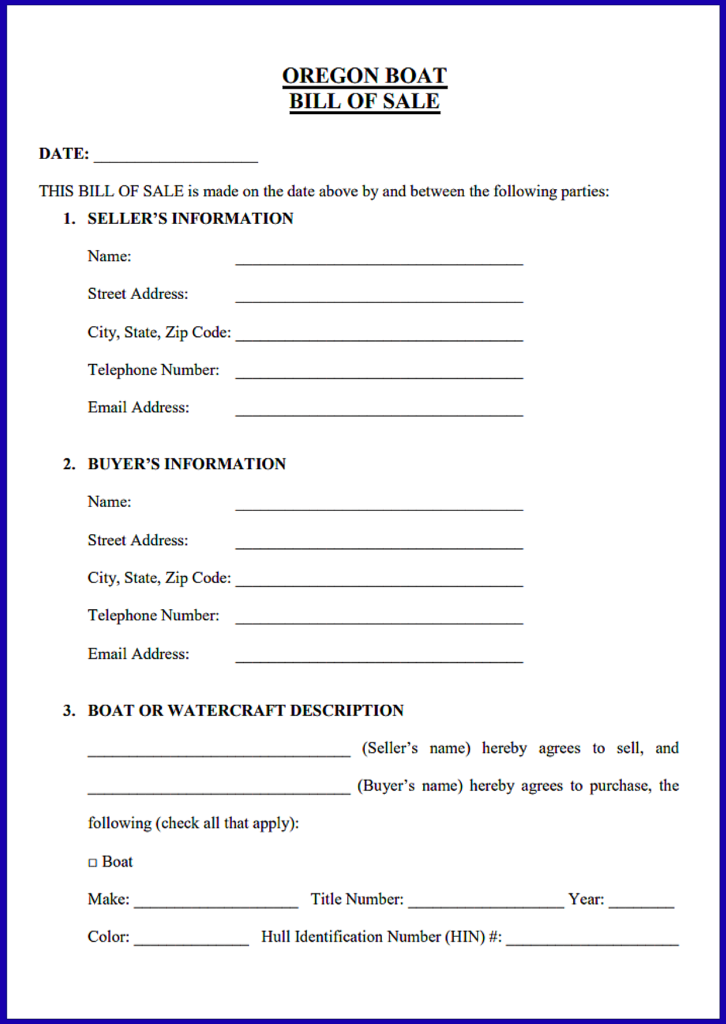
One of the most common mistakes I see is people thinking the boat and trailer are legally the same transaction. They’re not. In Oregon, the boat is handled through the Marine Board, while the trailer is typically processed through the Oregon DMV. That means you need proper documentation for both — including a separate boat trailer Boat Bill of Sale Oregon when applicable.
I’ve seen sellers get DMV notices months after a sale because the trailer paperwork wasn’t handled correctly. That’s avoidable. A properly drafted trailer bill of sale documents the VIN, sale price, and transfer date, protecting both parties from liability. I’ve included a downloadable PDF version of this form as well, so you can complete it accurately and avoid those headaches.
Oregon Boat Bill of Sale Form
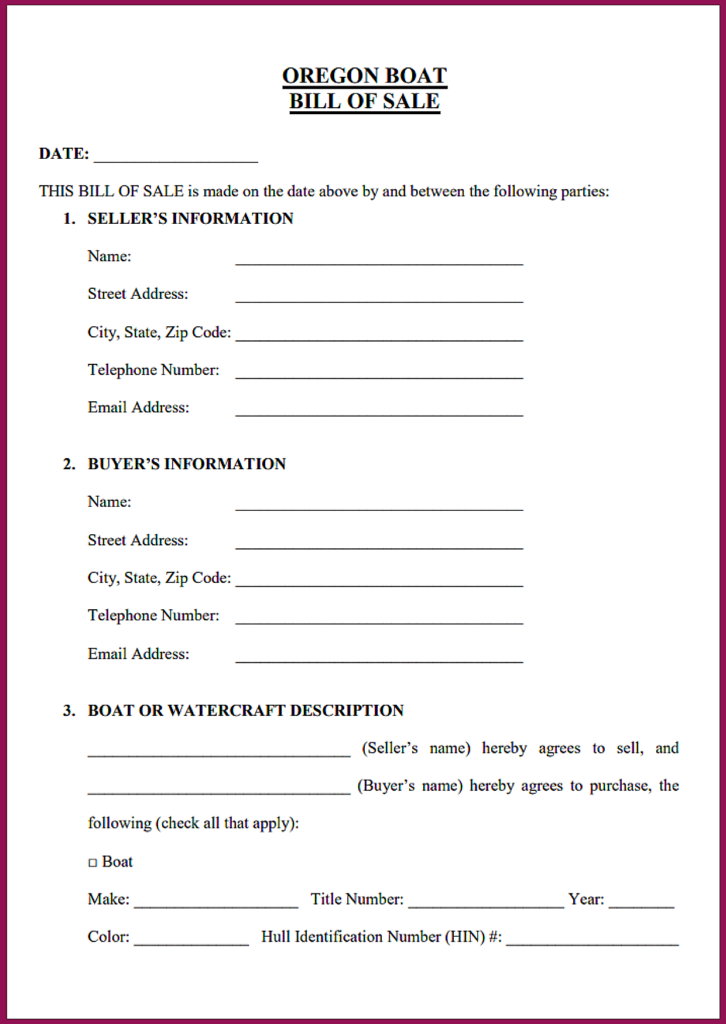
An Oregon Boat Bill of Sale form is a written legal document confirming the transfer of ownership of a boat within the state. It identifies the buyer, the seller, the vessel details, purchase price, and date of transfer. While Oregon doesn’t always mandate a separate bill of sale if the title is properly assigned, in my professional opinion, skipping it is a mistake.
I’ve seen too many disputes arise over engine defects, unpaid balances, or registration delays simply because the transaction wasn’t fully documented. A detailed bill of sale adds clarity and protection beyond the title itself. To make things easier, I’ve made this Oregon Boat Bill of Sale form available in downloadable PDF format so you can complete and print it properly.
Oregon DMV Boat Bill of Sale
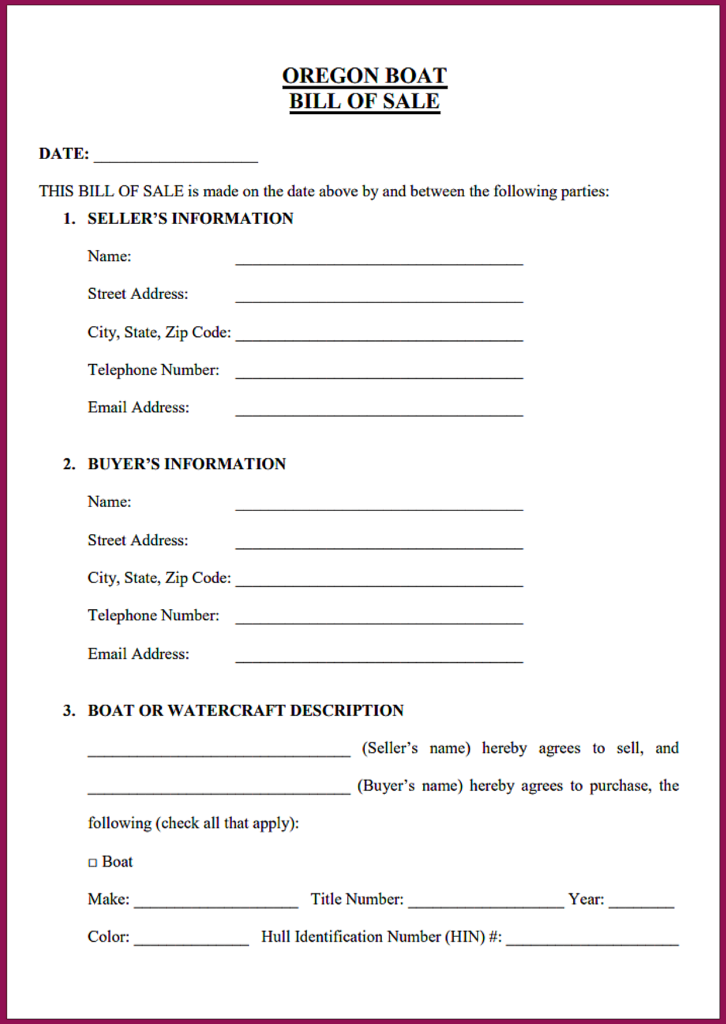
Now here’s where confusion often creeps in. People search for an “Oregon DMV Boat Bill of Sale,” but technically, boats are regulated by the Oregon State Marine Board, not the DMV — unless we’re talking about the trailer. That distinction matters more than most realize.
In practice, I’ve had clients show up at the DMV with boat paperwork only to be redirected. Understanding which agency handles which part of the transfer saves time and frustration. While the Marine Board manages boat registration and titling, documentation must still clearly support ownership transfer. I’ve provided a properly structured PDF version you can download to ensure your paperwork aligns with Oregon requirements.
First: Does Oregon Even Require a Bill of Sale for a Boat?
Short answer? Yes — practically speaking, you need one.
In Oregon, most boats are titled and registered through the Oregon State Marine Board, not the DMV (though trailers are handled by the DMV). When ownership changes, you need documentation proving that transfer.
If the boat is titled — and most motorized boats are — the title transfer is key. But here’s what people miss: the title alone often isn’t enough to protect you.
I always recommend a separate written bill of sale, even if the buyer and seller sign the back of the title. Why? Because when disputes happen, the bill of sale is what tells the full story.
What I Always Tell Clients to Include
When someone sits across from me and asks, “Brandon, what absolutely needs to be in this?” — here’s what I tell them.
1. Full Legal Names & Addresses
No nicknames. No “Mike from Salem.” Full legal names and current addresses for both parties.
I once handled a case where the seller used a shortened name, and when the boat was later involved in an accident, it created confusion over who actually transferred ownership. It delayed resolution for months.
2. Detailed Boat Description
Be specific:
-
Make
-
Model
-
Year
-
Hull Identification Number (HIN)
-
Oregon registration number
The HIN is the boat equivalent of a VIN. If that number is wrong or missing, the Marine Board will push back.
Personally, I double-check that number every time. One digit off can cause rejection.
3. Purchase Price
List the exact sale price. This matters for:
-
Tax purposes
-
Disputes
-
Valuation issues
-
Allegations of fraud
I’ve seen buyers claim they paid more than they did. I’ve seen sellers claim they sold for more to inflate value during a dispute. Clear numbers prevent arguments.
4. Date of Sale
This is critical.
In my experience, the date protects sellers more than buyers. If the boat is involved in an accident or environmental violation after the sale but before registration transfer, that date becomes very important.
5. “As-Is” Language
I strongly prefer including an “as-is” clause unless you’re offering warranties.
Most private-party boat sales in Oregon are as-is. Without that language, buyers sometimes try to argue implied warranties.
And trust me — mechanical disputes over boat engines are common.
Title Transfer vs. Bill of Sale — Don’t Confuse Them
Here’s where people trip up.
Signing over the title transfers ownership officially.
The bill of sale documents the transaction details.
They serve different purposes.
If you’re selling, don’t hand over the boat until:
-
The title is properly signed
-
The bill of sale is signed
-
Payment is confirmed and cleared
I’ve seen sellers release boats before checks cleared. That never ends well.
What About Boat Trailers?
This one surprises people.
In Oregon:
-
Boats → Marine Board
-
Trailers → Oregon DMV
If you’re selling the boat and trailer together, you’re actually handling two different legal transfers.
I always tell clients to prepare:
-
Boat bill of sale
-
Trailer bill of sale
-
Separate title transfers if both are titled
Skipping the trailer paperwork is one of the most common mistakes I see.
Common Problems I’ve Handled
Let me share a few patterns I’ve seen over the years:
The “I Thought He’d Register It” Situation
Seller assumes buyer will register promptly.
Buyer delays.
Months later, citations show up tied to the old owner.
This happens more than you’d think.
My advice? Submit a notice of sale promptly and keep copies of everything.
The Engine Dispute
Buyer purchases boat. Two weeks later, engine fails. Buyer claims seller “knew.”
Without an as-is clause? That gets messy fast.
The Missing HIN
Boat is sold without properly verifying the Hull Identification Number. Marine Board rejects transfer. Buyer can’t register. Seller is dragged back into the process.
All avoidable with careful documentation.
Do You Need Notarization in Oregon?
For most private boat sales in Oregon, notarization is not strictly required — but I sometimes recommend it if:
-
The boat is high-value
-
Parties don’t know each other
-
There’s tension or distrust
It adds an extra layer of credibility if things ever escalate.
Personally, if it’s a $25,000 fishing boat? I’d notarize it.
Why I Care About These Details
I’ve seen friendships end over sloppy paperwork.
I’ve seen small mistakes turn into five-figure disputes.
I’ve seen sellers dragged into lawsuits simply because they trusted a handshake.
What I’ve learned after years practicing in Oregon is this: clarity protects everyone.
The bill of sale isn’t about bureaucracy. It’s about protecting yourself from future liability.
A Gentle Legal Reminder
Every situation is different. High-value boats, inherited vessels, lien issues, estate sales — those require extra care. If there’s a loan on the boat, that’s a completely different conversation.
Nothing here is formal legal advice for your specific case — just guidance based on what I’ve handled over the years. If your situation feels complicated, it probably is.
My Personal Bottom Line
If you’re selling a boat in Oregon:
-
Put everything in writing
-
Be detailed
-
Include as-is language
-
Verify the HIN
-
Handle trailer paperwork separately
-
Keep copies of everything
And if you’re buying? Don’t rush. Ask questions. Inspect thoroughly. Protect yourself.
I’ve spent a lot of my career cleaning up preventable messes. I’d much rather help you avoid one.
If you’ve got questions about a boat bill of sale in Oregon — or you’re dealing with a situation that feels uncertain — drop a comment or reach out. I’m always happy to point you in the right direction.