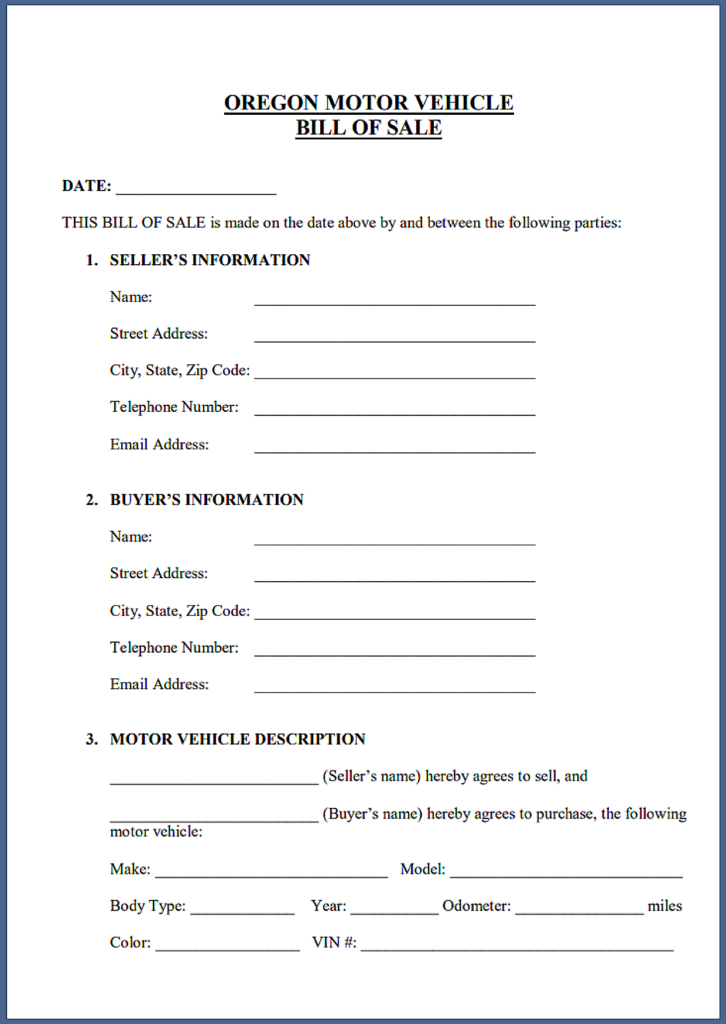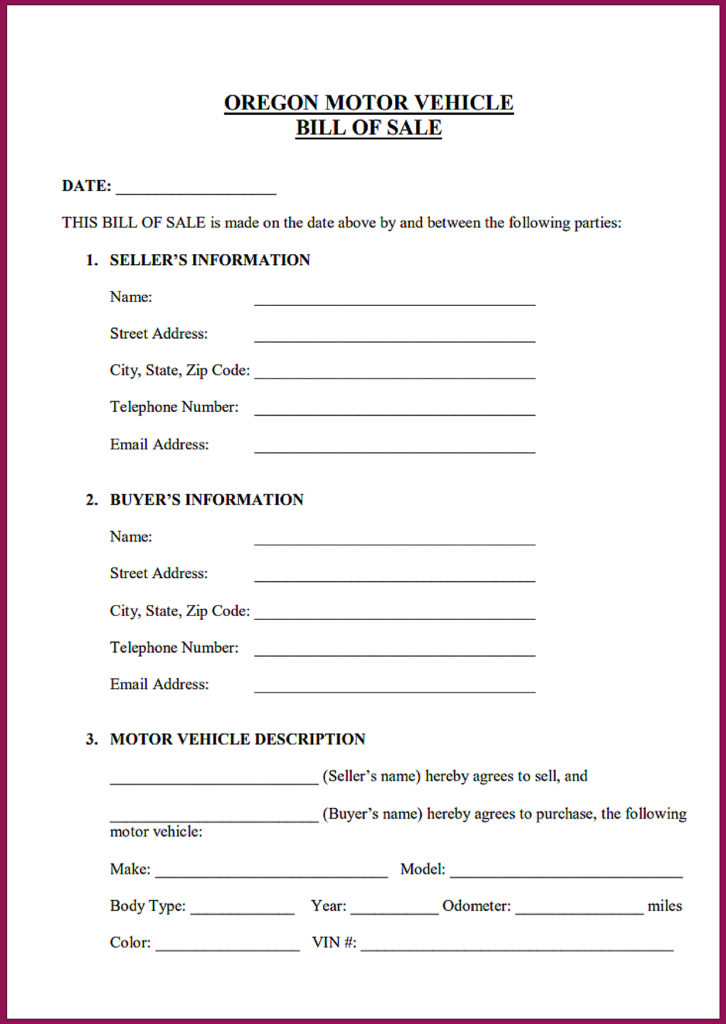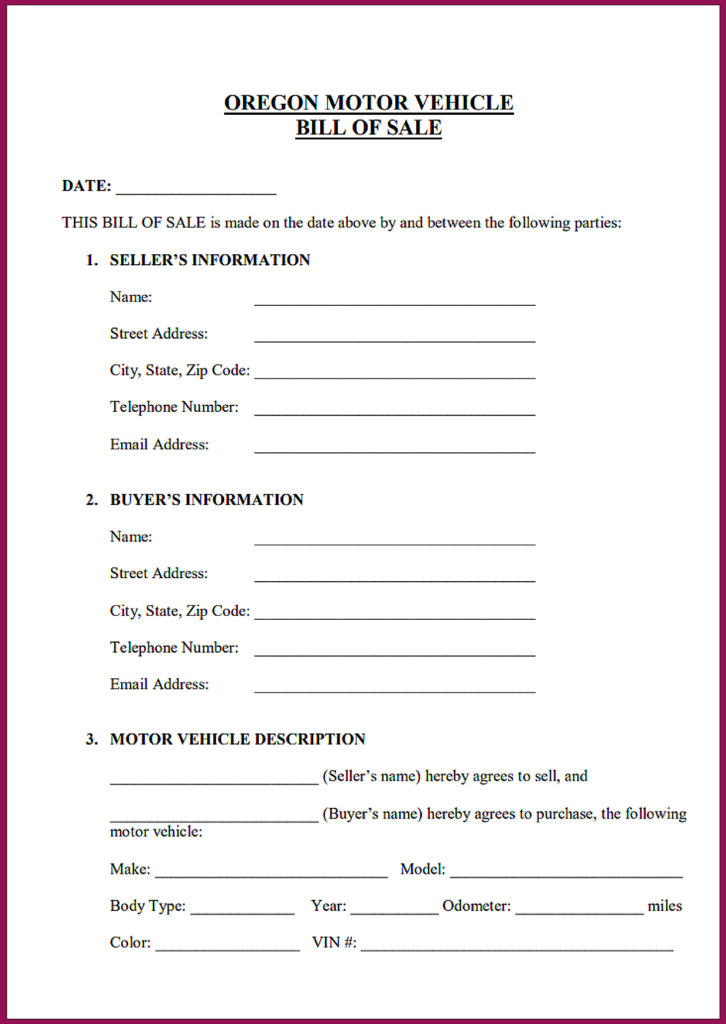
If you’re sitting across from me in my office in Oregon asking about a DMV Bill of Sale form Oregon, chances are something already went sideways. That’s usually how these conversations start. A private sale felt simple, paperwork felt optional, and now the Oregon DMV — or worse, another person involved in the deal — is saying something doesn’t line up.
For context, I’m an Oregon attorney who has spent years dealing with real vehicle sales, title transfers, and DMV disputes. A DMV Bill of Sale form in Oregon is a written record of a vehicle transaction — who sold it, who bought it, when it happened, and for how much. While it may seem like a “simple form,” I’ve seen firsthand how this one document can be the difference between a smooth transfer and months of stress, fines, or legal arguments.
I’ve handled every version of this issue: car sales between neighbors, Facebook Marketplace deals gone bad, family transfers that “didn’t need paperwork,” and title disputes that could’ve been avoided with one extra page signed at the kitchen table.
So let me walk you through how this actually works in Oregon — not the sanitized checklist version, but the real-world version shaped by cases I’ve handled, mistakes I’ve seen repeated, and people who genuinely thought they were doing everything right.
Free Printable DMV Bill of Sale form Oregon

In my experience, most people looking for a free printable DMV Bill of Sale form Oregon are trying to fix a problem quickly — sometimes even urgently. Either the vehicle has already changed hands, or the buyer and seller realized too late that “we’ll figure it out later” doesn’t work when the Oregon DMV asks for documentation. I’ve seen plenty of honest people get stuck simply because they didn’t have something in writing when they needed it most.
A printable bill of sale gives you a clear, written record of the transaction that protects both sides. I always recommend having a clean, easy-to-read copy you can sign, store, and reference later if questions come up. To make this easier, I’ve included a PDF version of this free printable Oregon DMV bill of sale below, which you can download and use right away for your records.
Oregon DMV Bill of Sale Legal Requirements
| Topic / Issue | [OREGON] Legal Rule | Governing Statute |
|---|---|---|
| Governing Legislation | Vehicle transfers, titling, odometer disclosures, and seller notices are governed by Oregon Vehicle Code. Commercial sale standards and warranty disclaimers are governed by Oregon UCC provisions. | Oregon Revised Statutes Chapter 803; Oregon Revised Statutes Chapter 72 |
| Federal Odometer Law | Federal Truth in Mileage Act and federal implementing regulations govern interstate odometer disclosure standards. | 49 U.S.C. § 32705; 49 C.F.R. Part 580 |
| Jurisdiction | Both state and federal law apply. Oregon law controls title transfers, registration, and notice filings, while federal law regulates mandatory odometer reporting. | ORS Chapter 803; 49 U.S.C. § 32705; 49 C.F.R. Part 580 |
| Recent Amendments | Federal odometer rules expanded the exemption window to vehicles under 20 years old, affecting model year 2011 and newer vehicles. Administrative updates to ORS 803.112 integrate digital submissions and online recordkeeping through DMV2U. | ORS 803.112; 49 C.F.R. Part 580 |
| Authorized Signers | The transferor and transferee listed on the title assignment or DMV bill of sale form, Form 735-501, are the parties to the transfer. For transactions involving goods priced at $500 or more, the document must be signed by the party against whom enforcement is sought. | ORS 803.102; ORS 803.092; ORS 72.2010 |
| Witness Requirement | No statutory requirement — governed by common law principles | N/A |
| Notarization Requirement | No statutory requirement — governed by common law principles | N/A |
| Age Requirement | Parties must be at least 18 years of age to possess full independent contractual capacity. | ORS 109.510 |
| Mental Capacity | No statutory requirement — governed by common law principles | N/A |
| Buyer Filing Deadline | The buyer must submit an application for title to the Oregon Department of Transportation within 30 calendar days of the date of transfer. | ORS 803.092(1) |
| Seller Notice Deadline | The seller must notify Oregon DMV of the vehicle transfer within 10 calendar days of the sale. | ORS 803.112 |
| Statement of Release and Vehicle Identification | An official or compliant bill of sale, such as Form 735-501, must contain at least the VIN, a clear statement releasing interest in the vehicle, the printed names and signatures of the seller(s), and the date of sale. | ORS 803.102 |
| Odometer Disclosure | For vehicles model year 2011 or newer and under 20 years old, the disclosure must state the numeric reading and certify whether the mileage is actual, in excess of mechanical limits, or not actual. | ORS 803.120; 49 C.F.R. § 580.5 |
| “As Is” Clause | To exclude implied warranties of merchantability and fitness in a private vehicle sale, the contract must contain conspicuous written language meeting Oregon’s requirements. | ORS 72.3160 |
| Filing Agency | The bill of sale or supporting documentation is submitted with the title-transfer application to ODOT / DMV. The seller must also submit a Notice of Sale online through DMV2U or by form within 10 days. | ORS 803.092; ORS 803.112 |
| Private Contract Status | A DMV bill of sale functions as an administrative document and supplementary transfer evidence, working alongside title assignments to establish the ownership chain. | No statutory requirement — governed by common law principles |
| False Statements | Knowingly submitting false statements, forged signatures, or material misrepresentations on a vehicle bill of sale or transfer document is unlawful and invalidates the transaction record. | ORS 803.070; ORS 803.114 |
| Missing VIN or Release Statement | Omitting the VIN or an explicit statement releasing ownership interest prevents the Oregon DMV from processing the form under the supplied vehicle-code standards. | ORS 803.102 |
| Active Lien | Attempting to transfer a vehicle subject to an active recorded lien without obtaining an original signed lien release from the security-interest holder invalidates the transfer process. | ORS 803.092 |
| State Sales Tax | Oregon does not impose a general statewide retail sales tax or use tax on private vehicle transactions. | Oregon state tax rule |
| Seller Protection | Oregon’s mandatory 10-day seller notice provides a formal state-level tracking window intended to protect sellers from post-sale civil-liability issues. | ORS 803.112 |
| License Plates | Registration plates assigned to an Oregon vehicle remain with the vehicle when ownership changes, subject to specific custom-plate exceptions. | ORS 803.530 |
The most important distinction here is that the DMV bill of sale is not just a receipt. Under the supplied Oregon rules, a compliant form must contain the VIN, a statement releasing the seller’s interest, the seller’s printed name and signature, and the sale date. Leaving out the VIN or release statement can prevent DMV from processing the document.
The timing rules matter just as much. The buyer has 30 calendar days to submit the title application, while the seller has only 10 calendar days to notify DMV. These are separate responsibilities.
The odometer requirement can also cause a rejection if it is missed. For a 2011-or-newer vehicle under 20 years old, the disclosure must state the mileage and identify whether it is actual, exceeds mechanical limits, or is not actual. An active lien is another serious issue because the supplied rules require an original signed lien release.
Getting the paperwork wrong can mean DMV cannot process the transfer, while false information or forged signatures can create statutory problems. Oregon’s plate rule is also unusual because plates generally remain with the vehicle, subject to the stated exceptions.
Oregon DMV Bill of Sale Template
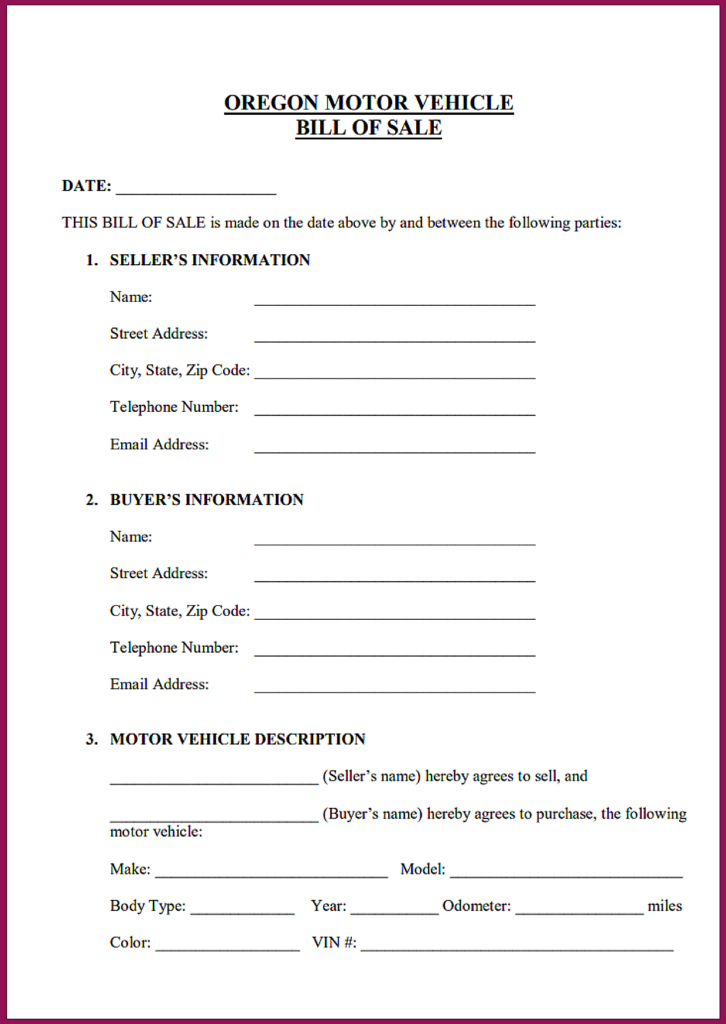
When clients ask me for an Oregon DMV bill of sale template, what they’re really asking is, “What wording won’t cause problems later?” And that’s a fair concern. I’ve reviewed homemade templates pulled from the internet that looked fine at first glance but left out key details that later turned into disputes over dates, prices, or even ownership itself.
A proper template keeps things simple but legally clear — buyer, seller, vehicle details, and signatures, all laid out in a way the Oregon DMV can understand without confusion. I strongly prefer using a clean, structured template rather than writing something from scratch. For convenience, I’ve also added a downloadable PDF version of this Oregon DMV bill of sale template, so you can save it, print it, and use it when you’re ready.
Oregon DMV Vehicle Bill of Sale Form
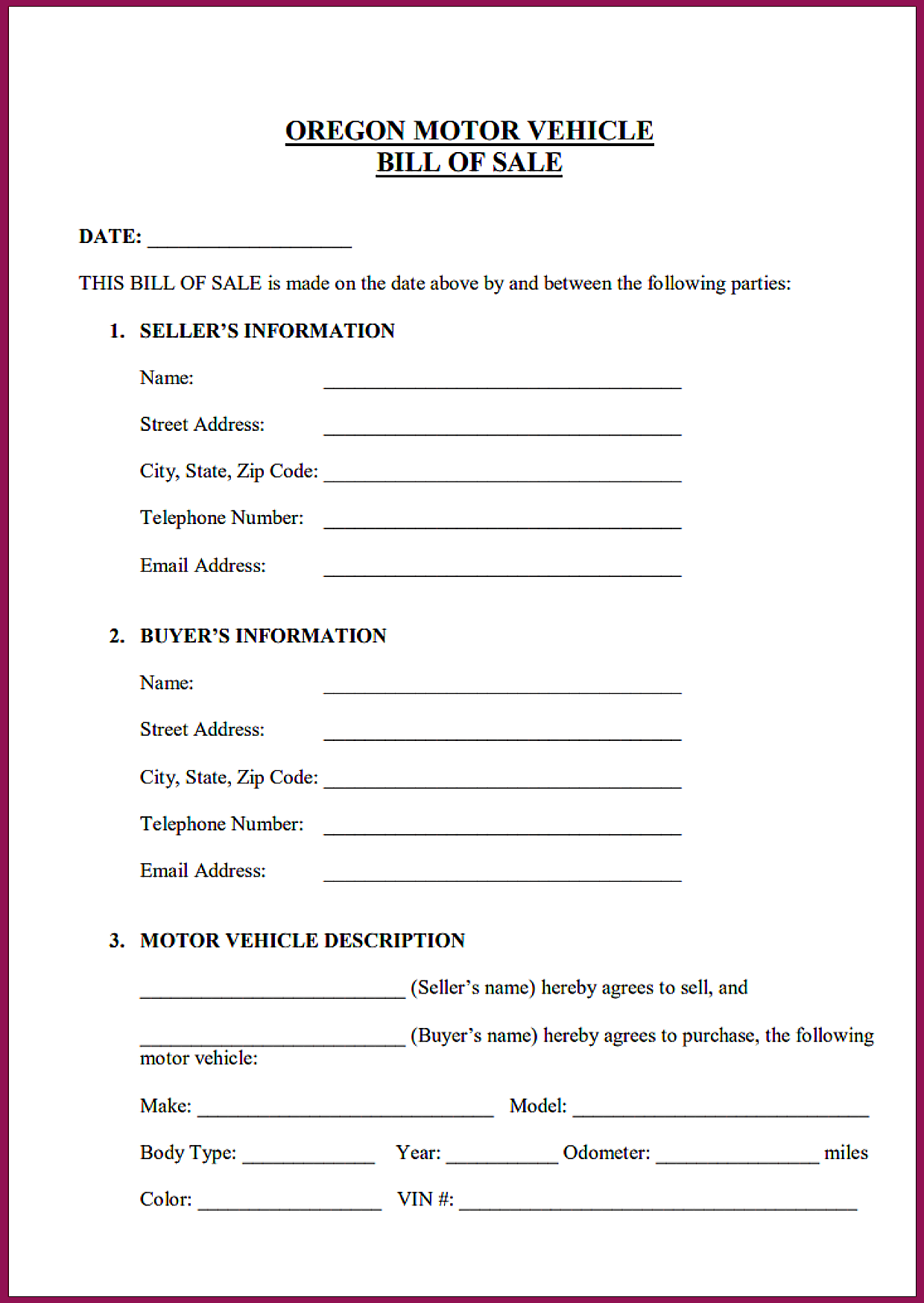
A lot of people don’t realize that an Oregon DMV vehicle bill of sale form isn’t just paperwork — it’s proof. Proof of when the sale happened, who was involved, and what exactly was agreed to. I’ve handled cases where that single document stopped a seller from being blamed for tickets, towing fees, or even accidents that happened after the car was sold.
From a legal standpoint, this form acts like a receipt with teeth. It helps establish a timeline and separates responsibility between buyer and seller. Personally, I always advise clients to keep a signed copy with their personal records, even if the title transfer seems straightforward. To help with that, I’ve included a PDF version of the Oregon DMV vehicle bill of sale form here, which you’re welcome to download and use.
Oregon DMV Bill of Sale Printable
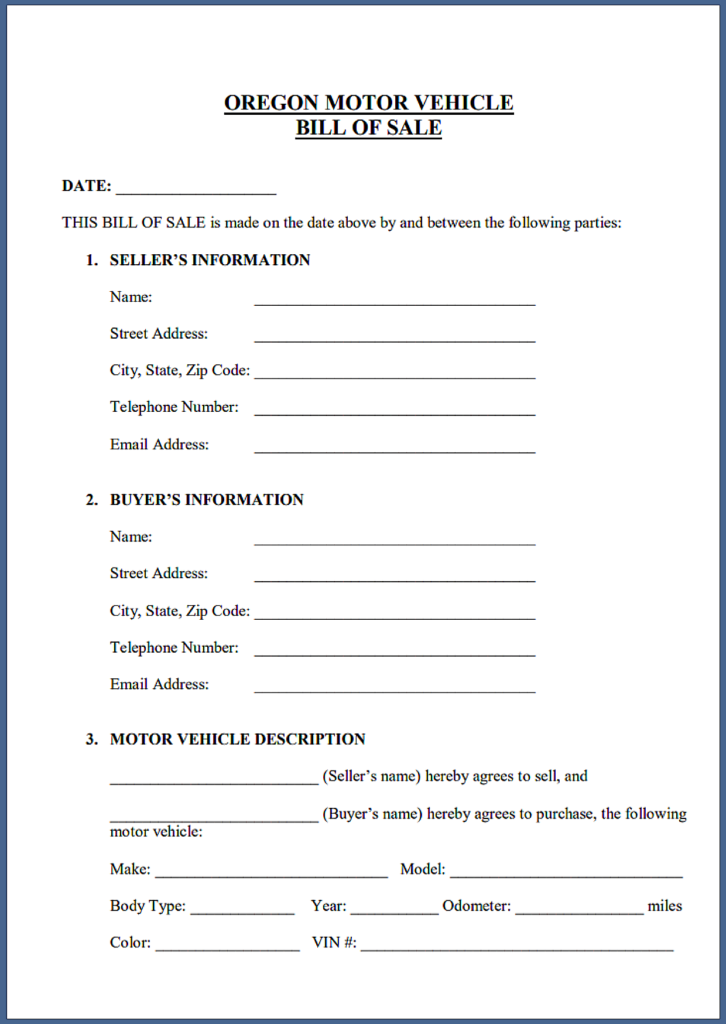
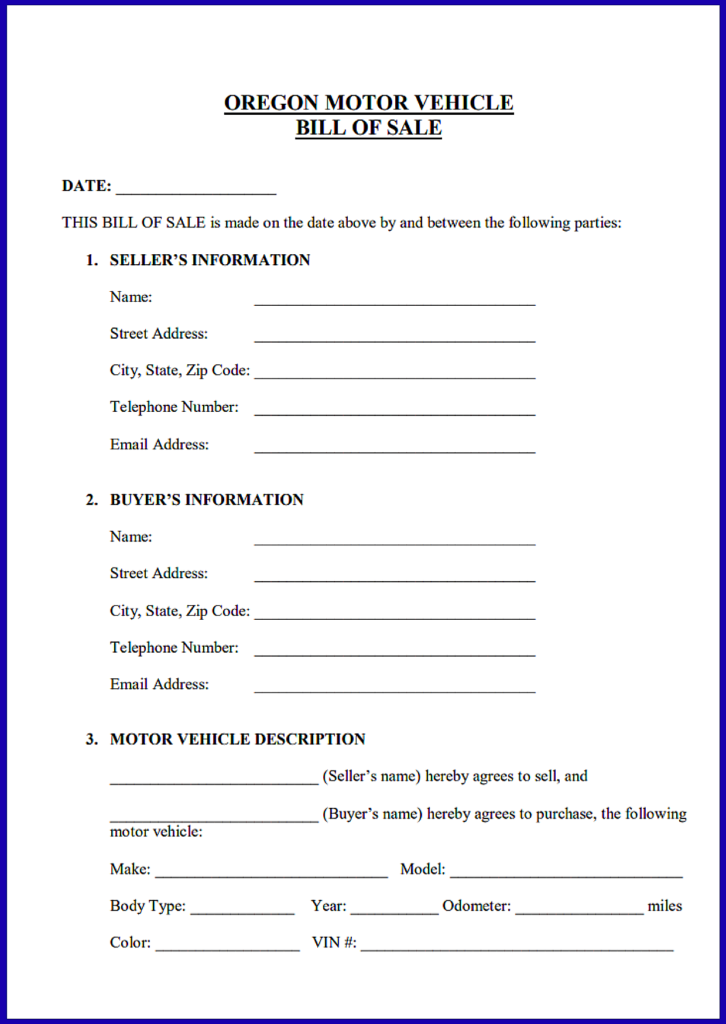
When someone asks me for an Oregon DMV bill of sale printable, it usually means they want something simple, fast, and reliable — not a complicated legal document that needs interpretation. And honestly, that’s exactly how it should be. A printable form allows you to handle the sale at your kitchen table, in a parking lot, or wherever the deal happens, without cutting corners.
What I’ve learned over the years is that having a printed, signed bill of sale prevents misunderstandings later on. Even when the DMV doesn’t strictly require it, having that paper trail gives you peace of mind. For that reason, I’ve made a printable PDF version of the Oregon DMV bill of sale available below, so you can download it, print it, and keep a copy for your own protection.
Do You Actually Need a Bill of Sale in Oregon?
Here’s the truth most people don’t realize until it’s too late.
In Oregon, the Oregon Department of Motor Vehicles does not always require a bill of sale to transfer a vehicle. The title is the main document. That technicality trips people up all the time.
But in my experience, relying on “not required” is risky.
I’ve seen situations where:
-
The title was lost after the sale
-
The seller passed away before the transfer was complete
-
The buyer never registered the vehicle, then got into an accident
-
A lien issue popped up months later
When that happens, the bill of sale becomes the one piece of paper that can save you.
Personally, I strongly prefer always having a bill of sale — even when DMV technically says you can skip it.
What the Oregon DMV Bill of Sale Should Include (And Why It Matters)
Oregon doesn’t mandate a specific official bill of sale form for vehicles, which gives people a false sense of freedom. I’ve reviewed dozens of homemade versions that caused problems later.
What I’ve learned is this: simplicity is fine, but missing details are expensive.
At a minimum, I always recommend including:
-
Full legal names and addresses of buyer and seller
-
Vehicle year, make, model, and VIN
-
Sale price (or a clear statement if it’s a gift)
-
Date of sale
-
Signatures from both parties
Here’s why this matters. I once handled a dispute where the buyer swore the sale happened in June, the seller said August, and parking tickets piled up in between. The bill of sale date ended that argument instantly.
Paper beats memory every time.
An Out-of-State Vehicle Needs More Than a Signed Bill of Sale
This is one of the first things I would check if the vehicle was purchased outside Oregon. A signed Oregon DMV bill of sale does not by itself complete the Oregon title process for an out-of-state or foreign-titled vehicle.
Oregon DMV requires a VIN inspection when a vehicle with an out-of-state or out-of-country title is being titled in Oregon. The inspection physically verifies that the VIN on the vehicle matches the title or ownership document. The current Oregon DMV fee is $9.
There is a useful detail if the vehicle has not reached Oregon yet. The inspection can be performed by the other state’s DMV or a law enforcement officer in that state, and Oregon can accept that state’s inspection form. Oregon does not charge its $9 inspection fee for an inspection performed in another state, although that state may charge its own fee.
I would also keep the bill of sale with the original out-of-state title and the other ownership documents. Oregon DMV’s title instructions specifically list the original title, releases or bills of sale from previous owners, required odometer disclosure, and VIN inspection among the documents that may be needed.
The Odometer Disclosure Trap
This one causes more headaches than you’d expect.
If the vehicle is under 10 years old, federal and Oregon law require an odometer disclosure. Sometimes that’s done on the title itself. Sometimes people think the bill of sale replaces it. It doesn’t.
I’ve had clients come in frustrated because DMV rejected their paperwork, and all it took was a missing mileage entry.
My rule of thumb:
If there’s space on the title — fill it out carefully. If not, attach a separate odometer disclosure and keep a copy with the bill of sale.
It’s boring paperwork — until it isn’t.
Private Sales vs. Family Transfers
This is where emotions sneak into legal decisions.
People selling to friends or family often say, “We trust each other.” I get that. I really do. But trust doesn’t stop DMV notices from showing up in your mailbox.
I once represented a man who sold a truck to his cousin. No bill of sale. No notice of sale filed. Six months later, he’s dealing with towing fees and traffic violations that weren’t his.
What I’ve learned is this:
Family deals need clearer paperwork, not looser paperwork.
If it’s a gift, say it’s a gift. Write “$0” or “gift” clearly. Ambiguity is what causes problems.
Filing the Notice of Sale — Don’t Skip This
This is one step I’m borderline opinionated about.
After selling a vehicle, I always recommend filing a Notice of Sale with Oregon DMV immediately. Online is fine. Same day is better.
Why? Because until DMV updates its records, you may still be legally connected to that vehicle.
I’ve seen sellers dragged into:
-
Toll violations
-
Parking citations
-
Accidents
-
Abandoned vehicle claims
All because they didn’t file that notice.
It takes minutes. It can save months.
Common Oregon DMV Bill of Sale Mistakes I See
These come straight from real case files:
-
VIN written incorrectly (one wrong digit is enough)
-
Signatures that don’t match the title
-
White-out or altered numbers (DMV hates that)
-
Missing sale date
-
Assuming a handshake is “good enough”
If something feels informal now, it often becomes formal — and expensive — later.
A Quick Legal Reality Check
I’ll say this the same way I say it to clients:
This isn’t legal advice for your exact situation — Oregon vehicle law has nuances, and facts matter. But these principles come from years of handling real disputes, not theory.
If something already feels off about your sale or transfer, trust that instinct and get advice sooner rather than later.
Final Thoughts From My Desk
What I’ve learned over the years is simple:
A bill of sale isn’t about bureaucracy. It’s about clarity.
Clarity protects buyers.
Clarity protects sellers.
Clarity prevents “I thought you were going to…” conversations six months down the line.
If you’re unsure how to draft one, wondering whether your situation needs extra documentation, or already dealing with a DMV headache — I’m happy to talk it through.
Feel free to leave a comment, ask a question, or reach out directly. I’ve probably seen a version of your situation before, and if I haven’t, I’ll tell you that too.
FAQs
Is a DMV Bill of Sale form required in Oregon?
In Oregon, the Oregon Department of Motor Vehicles does not always require a bill of sale to transfer a vehicle if the title is properly signed over. That said, in my real-world legal experience, not having one is one of the most common reasons people end up back in my office later with a problem. Personally, I treat the bill of sale as essential, even when it’s technically optional.
What is a DMV Bill of Sale form in Oregon used for?
At its core, a DMV Bill of Sale form Oregon is proof that a vehicle transaction actually happened. It documents who sold the vehicle, who bought it, when the sale occurred, and for how much. I’ve seen this form resolve disputes over parking tickets, toll violations, and even ownership claims when memories didn’t match and stories changed.
Can I handwrite a bill of sale in Oregon?
Yes, you can. Oregon allows handwritten bills of sale, and I’ve seen plenty accepted without issue. That said, handwritten forms are also where mistakes happen most often — missing VINs, unclear dates, or unreadable handwriting. I strongly prefer using a clean, printable form. That’s why I’ve included a downloadable PDF version you can print and use, which helps avoid unnecessary DMV delays.
Does an Oregon bill of sale need to be notarized?
No, Oregon does not require notarization for a vehicle bill of sale. I still get this question almost weekly. While notarization can add an extra layer of formality, it’s not mandatory. What matters more is accuracy — correct vehicle information, clear signatures, and matching details with the title.
Is a bill of sale required for private vehicle sales in Oregon?
For private sales, a bill of sale isn’t always legally required, but in practice, it’s one of the smartest things you can do. I’ve handled cases where a private seller skipped the bill of sale and later received fines or notices because the buyer never registered the vehicle. A signed bill of sale helps establish the exact date ownership changed hands